Angerona Ambrasaitė is a researcher, architect and cultural practitioner based in Vienna. Her work spans analytic philosophy, aesthetics, architecture, contemporary artistic and literary practices, political analysis and security studies. She studied philosophy, political science, theology, art history, Slavic studies and architecture in Germany, Sweden, the Czech Republic and Israel. Her professional experience spans architecture, contemporary art, European cultural policy, publishing and education. She has worked in architectural practices in Frankfurt and Vienna, at the European Commission in Brussels, and with galleries and cultural institutions in Germany, Belgium, Austria and Lithuania. Her research, editorial work and interdisciplinary collaborations include contributions to projects at Schirn Kunsthalle Frankfurt, Literaturhaus Wien and the University of Applied Arts Vienna (die Angewandte), exploring art theory, philosophy and the democratisation of the public sphere. She is currently art director at a publishing house in Berlin. Her research interests centre on the political and theological dimensions of architecture and visual culture, disinformation and hybrid threats, the relationship between aesthetics and political authority, and the role of artistic and spatial practices in shaping collective identities.
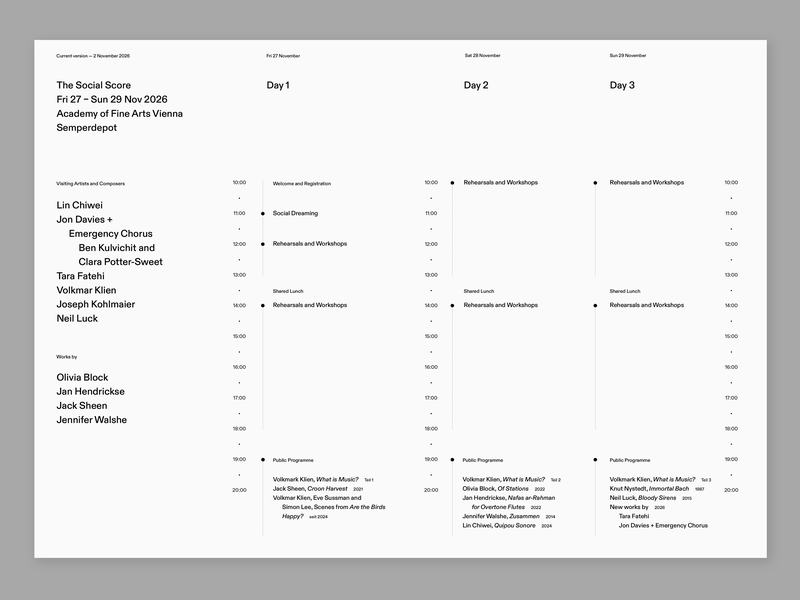
Olivia Block is a media artist and composer. She is the recipient of the 2026 Alvin Lucier Award for music/sound from The Foundation for Contemporary Arts. Her discography, spanning nearly thirty years, is published on Another Timbre, Black Truffle, Erstwhile, Ina GRM, NNA Tapes, Room40, Sedimental, and Touch, among other labels. She performs live experimental music, where at any given concert she might be playing electronic instruments, piano, organ or amplified objects. Block also creates surround sound concerts, sound installations and scores. Her most recent live performances are long experimental songs for voice, piano, and electronics. She composes for chamber ensemble, orchestra and pipe organ. Block has performed, premiered and exhibited her work throughout Europe, America, and Japan in tours in festivals and performance series including Rewire, MoogFest, Festival del Bosque Germinal, Sonic Light, Redbull Academy, Kontraste, Archipel and many others. Her installations have been shown at The Nasher Sculpture Museum, The Richard H. Driehaus Museum, Arthur Ross Gallery at University of Pennsylvania, CEAM at Flagler University, MCA Chicago, Moss Arts Center at Virginia Tech, Museo Reina Sofia, The Smart Museum at University of Chicago, Manhattan Museum of Arts and Design, Sokolowsko Sanitorium (Poland), CONTEXT (Miami and NY) and The Jay Pritzker Pavilion in Millennium Park (Chicago). She has taught at The School of the Art Institute in the Sound Department and at Northwestern University in the Sound Arts and Industries program. She has completed many university teaching residencies and teaches workshops around the world. Olivia is based in Chicago and Northern New Mexico. She travels widely for her work.
Born in Taipei in 1971, Lin Chiwei is a transdisciplinary artist who received academic training in French literature, cultural anthropology and media art. Since the early 1990s, Lin has been involved in the Taiwanese counter-cultural scene. He was a founding member of noise band Z.S.L.O. and responsible for the programming of various alternative art festivals. At the same time, Lin explored the realms of religious music and art, notably temple sculpture and Taoist rituals, through intense research and field studies. These experiences, combined with his practice in noise performance and electronic music composition, developed into critical positions toward contemporary art practices. Since 2004, Lin has worked on the Tape Music and IDCM (Interhuman Dynamic Coordinated Models) series of works – synchronous protocols which allow individual autonomy in the forming of collective intelligence that leads to complex sound works. In his 2012 book Beyond Sound Art – The Avant Garde, Sound Machine and the Modernity of Hearing, Lin denies the term ‘Sound Art,’ and provides a holistic view blurring the boundary between human culture and technology. Lin’s art works were shown in various biennales and museums including Tate Modern, Pompidou Center, PSA Shanghai along with other non-art sites including local community projects, private residences, public schools, factories, churches, temples, bars and live venues in different countries around the world. Lin Chiwei lives and works in Shanghai, Taipei, and Paris.
Jon Davies is a musician, events organiser and irregular writer based in Liverpool. He produces music under the Kepla moniker, releasing albums on various labels including Purple Tape Pedigree, Chinabot, Entr'acte, Alien Jams among others. He has collaborated across disciplines with a wide range of artists including DeForrest Brown, Jr. (aka Speaker Music), Steven Warwick, Nathan Jones, Jade Montserrat and others. His practice is currently in long transition, moving into participatory group improvisations with audiences, theatre makers and other musicians, exploring the non-verbal negotiations of choreography and musicking, and dispersing the audience's gaze away from the singular stage. Along with composer and researcher Lola de la Mata, Jon also co-curates PEARL, a new sound art and performance series based in Liverpool.
Emergency Chorus is the collaboration between artists Ben Kulvichit and Clara Potter-Sweet. Since 2016, they have been working across theatre, live art and dance, creating performances which collide disparate source materials to form collages of text, choreography, music and image. Their work deals with states of crisis and emergency, the relationships between ecology, capitalism and technology, and ways of approaching and the future, doing so with complexity, strangeness, playfulness, intimacy and ambiguity. Previous works include Ways of Knowing, Town Criers, and Landscape (1989), and have been presented across the UK at venues such as Battersea Arts Centre, Cambridge Junction, Fierce Festival and Bristol Old Vic.
Tara Fatehi is a performance artist working across voice, dance, and text. Born in Tehran, her politically charged practice is entangled with everyday banality, unfolding through multivocality, unfinishedness, ambiguity, and play. Her work draws on histories, archives, found dance, and rebellious spectral voices. She has performed at Southbank Centre, V&A Museum, Nottdance, Cafe OTO, Montpellier Danse, ICA, and Oslo Dansens Hus, as well as in parks, streets, warehouses, and galleries. She is co-founder of From the Lips to the Moon, an ongoing experimental music and spoken word night; author of Mishandled Archive (LADA, 2020), a series of 365 public interventions; and vocalist with People of the Wind (Akazib, 2025).
Jan Hendrickse is an artist, performer, researcher and educator, receiving commissions for concert performance, installation works and dance scores. He has appeared with a range of artists from electronic and freely improvised musics, such as Ornette Coleman, Mark Fell, Rian Treanor and David Toop, as well as featuring regularly as a soloist on traditional instruments for major film scores. He designs, makes and modifies instruments for performance and workshop processes. He trained as a western Classical flute player, but has researched and studied many other flute traditions. He now performs mostly with self-made and traditional instruments including Turkish Ney, Tanzanian Filimbi, Chinese Xiao and Dizi as well as Rajasthani Satara and Alghoza. Jan has taught Turkish Ney at the Yunus Emre institute in London as well as in private classes. Jan teaches socially-engaged practice and practice-based research at the Guildhall School of Music & Drama and has also led creative projects in communities around the world including Gambia, Thailand, Germany and Gaza and the West Bank. His PhD research examined the epistemic models adopted in creative practice. He is experienced in facilitating conversations and interviews and has chaired discussions with the musicologist Georgina Born and artists Mark Fell, Michael Gordon and CC Hennix, amongst others.
Volkmar Klien (*1971, Hollabrunn, Austria) composes and improvises music. He makes installations and creates performances alongside work that sits between established descriptors. He also regularly collaborates with other artists. Having grown up in Vienna – fascinated by the city’s glorious musical traditions and rituals – Klien has ever since been invested in extending traditional practices of composing, producing, and listening far beyond the established settings of concert music. He is interested in navigating the manifold links between the different modes of human perception, the spheres of presentation, and the roles these play in the communal generation of meaning. While he regularly uses novel forms of technology, he sees himself within the age-old and manifold traditions of artists, thinkers, and simple minds trying to make sense of it all. He has a background in musical academia with a focus on digital sound and music. Klien has held positions at institutions such as the University of Music and Performing Arts Vienna, the Royal College of Art (London), the London College of Communication (London), and the Austrian Research Institute for Artificial Intelligence (Vienna). He is a professor of musical composition at the Anton Bruckner University in Linz.
Joseph Kohlmaier is an artist, designer and teacher. Until April 2026, he was Associate Teaching Professor in history and theory at the School of Art, Architecture and Design, London Metropolitan University. He is the founder and creative director of several collectives, organisations and educational projects, including Field Studies, experimental choral ensemble Musarc (2009–present), graphic design studio Polimekanos (with Stefan Kraus, 2000–2020), and independent imprint Cours de Poétique. It is through these frameworks that Joseph’s practice evolves, and where it has had the greatest impact by creating spaces for people to experiment with new ideas. As a curator and producer, Joseph has commissioned and worked with emerging and established artists, and collaborated with leading arts organisations in the UK and Europe on projects that have transformed the landscape of education, contemporary music and performance. Joseph’s work is multifaceted, situated at the intersection of different disciplines and activities that oscillate between solitary practice and collective performance. It is animated by the question of how we learn, how thought is related to symbolic form, the agony and potential of collective acts, the general ecology of the chorus, and marginalised ways of thinking such as the role of embodiment and felt sense in the production of knowledge. Joseph is the founder of Field Studies and acts as its artistic director. He teaches the Vienna chapter of Figures of Eight.
Neil Luck is a composer and artist based in the UK. His work often explores the pathos and interaction between live human performance and multimedia, and attempts to frame the act of music making as something curious, or weird, or useful, or spectacular in and of itself. Neil’s work takes a range of forms from music-theatre, to concert works, radio, public projects and recordings. He is the founder and director of the music-theatre ensemble ARCO; an experimental music-theatre company. ARCO has been commissioned to produce work for arts institutions, galleries and music institutions around the UK and overseas. Neil has worked with and written for people and ensembles in the UK and abroad, and presented work at music venues, festivals, and galleries internationally including Tate Britain, Tate Modern, BBC Proms, Aarhus and Vilnius European Capital of Culture festivals (2017, 2009), V&A, Tokyo Experimental Festival, London Contemporary Music Festival, BBC Radio 3, Venice Biennale, ICA, Whitechapel Gallery, MATA Festival (New York), BBC Proms, Palais de Tokyo (Paris), November Music, Klangforum Wien, Apartment House, and Explore Ensemble. Neil also performs with artist Jennifer Walshe in the duo WACK, touring internationally. His music has been released on several labels including Entr’acte, Nonclassical, Accidental Records, and squib-box. Neil holds a PhD from the University of York, and is currently professor of Experimental Music Performance at the Royal College of Music, London. www.neilluck.com
Jack Sheen (1993) is a composer and conductor from Manchester whose practice spans orchestral and chamber compositions, installations, electroacoustic music, and site-specific spatial performances. His music has been commissioned by many of the orchestras and ensembles he regularly conducts such the London Symphony Orchestra, BBC Philharmonic and Scottish Symphony Orchestras, Manchester Camerata and London Sinfonietta, alongside organisations such as the Venice Biennale, Camden Art Centre and PINK. Recent projects include Lap/Trough, co-commissioned by BBC Symphony Orchestra, Luxembourg Philharmonic, and WDR Symphony Orchestra Cologne; Ceremony Container, a concert-installation for Silent Green and Ensemble Mosaik (Berlin); and Surface to Air, a performance, sound installation, and LP created in collaboration with the artist Anri Sala for Fundação de Serralves (Porto). His music has been released by The Trilogy Tapes (Press, 2026; Croon Harvest, 2024; Solo for Cello, 2023) Black Truffle (The Vestige, 2025), and SN Variations (Sub, 2022). Jack is Artist in Association at London’s Wigmore Hall.
Axel Stockburger is an artist and theorist based in Vienna. He is Associate Professor for Art and Cultural Studies at the Academy of Fine Arts, Vienna. Axel studied Visual Media Arts with Peter Weibel at the University of Applied Arts, Vienna and Art History as well as Philosophy at the University of Vienna. In his PhD from the University of the Arts, London, he researched the spatiality of digital games in the context of contemporary art. In his art and research, Stockburger focused on a wide range of different phenomena, tracing the paradigm shift in how culture is produced and consumed that emerged with digital technologies. He produced artworks engaging with global forms of fan culture and cosplay, as well as digital play and games. In his theoretical work he began to focus more specifically on questions of canonization and the critique of the canon, in contemporary art. His videos and installations have been exhibited internationally. He is a member of the research group Technopolitics and, since 2020, a member of the board of the artist association Secession, Vienna. stockburger.at
‘The most original compositional voice to emerge from Ireland in the past 20 years‘ (The Irish Times) and ‘Wild girl of Darmstadt’ (Frankfurter Rundschau), composer and performer Jennifer Walshe was born in Dublin, Ireland. Her music has been commissioned, broadcast and performed all over the world. She has been the recipient of fellowships and prizes from the Foundation for Contemporary Arts, New York, the DAAD Berliner Künstlerprogramm, the Internationales Musikinstitut, Darmstadt and Akademie Schloss Solitude among others. Many of Walshe’s recent projects focus on the planet Mars, using it as a lens to think through the most pressing issues of our time. Notable projects from this series include MARS I, for Klangforum Wien and Some Notes on Martian Sonic Aesthetics 2034–51 for Ensemble Modern, culminating in MARS (2025) for Irish National Opera. Another recent project is the music-theatre work The Alonetimes, written with Philip Venables, which premiered at the Fondation Cartier in Paris in April 2026. Walshe has worked with AI for over a decade, and her book 13 Ways of Looking at AI, Art & Music was published by Unsound in 2024. A Spanish translation was published by Alpha Decay (Barcelona) in 2025. Recent albums include In the Merry Month of May (Blue Chopsticks, 2024), Walshe’s duo album with Tony Conrad, which was chosen as an album of the year by The Wire, The Vinyl Factory and KLOF Magazine. Walshe’s double album An Gléacht/Dordán (Diatribe, 2024) received the Académie Charles Cros Coup de Cœur for Experimental Music. Walshe is Professor of Composition at the University of Oxford. Her work has been profiled in many publications including The New Yorker.